
Designing Residential Lighting for Different Ages and Daily Routines
A home shared by children, working adults and older relatives needs more than one comfortable light level. The entrance handles outdoor clothing and deliveries, the kitchen supports detailed tasks, and bedrooms are used for both preparation and rest. Nighttime movement introduces a separate requirement: enough visibility to navigate without exposing the entire household to a bright ceiling light. Planning around these routines leads to better decisions about luminaire position, controls and glare than choosing one fixture style for every room.
Make entrances and corridors easy to read
A hallway provides the transition between bright daylight, outdoor darkness and interior rooms. Place illumination where people identify steps, door handles, storage and floor changes. A single fixture in the centre may leave a coat cupboard dark when an open door blocks its beam. Wall or ceiling lighting with a broad, controlled distribution can support orientation along a passage, while a lower-level source can help reveal a change in floor height. Keep the visible emitter away from direct eye lines where possible.
Controls should follow movement. A switch near the entrance and another at the opposite end of a long corridor are more practical than a single control far from the rooms people enter. Motion sensing can be useful in selected circulation areas, provided its detection coverage matches the approach direction and operating time. In homes with children or visitors, clear switching is easier to understand than controls that depend entirely on a phone. The lighting plan should also account for furniture that may later occupy a hallway wall.
Give the kitchen enough light at the working surface
Kitchen light is successful when people can see the cutting board, hob surround and sink without standing in their own shadow. Ceiling fittings alone can leave the front of a worktop poorly illuminated when upper cabinets obstruct the beam. Under-cabinet linear luminaires provide a closer source for preparation, but they need to be positioned so that exposed diodes do not reflect in polished stone or glossy splashbacks. A diffuser and suitable setback can improve comfort while maintaining useful illumination.
The kitchen often connects visually to a dining or living area. Coordinate the appearance of white light in adjacent zones while allowing different brightness levels for cooking and conversation. Decide how the countertop, island and background lights will be switched separately. Any low-voltage furniture lighting needs an appropriate supply and a protected cable route planned with the cabinet maker. The power equipment should remain accessible for servicing, and components must be installed according to their specifications.
Balance relaxation, hobbies and screen use
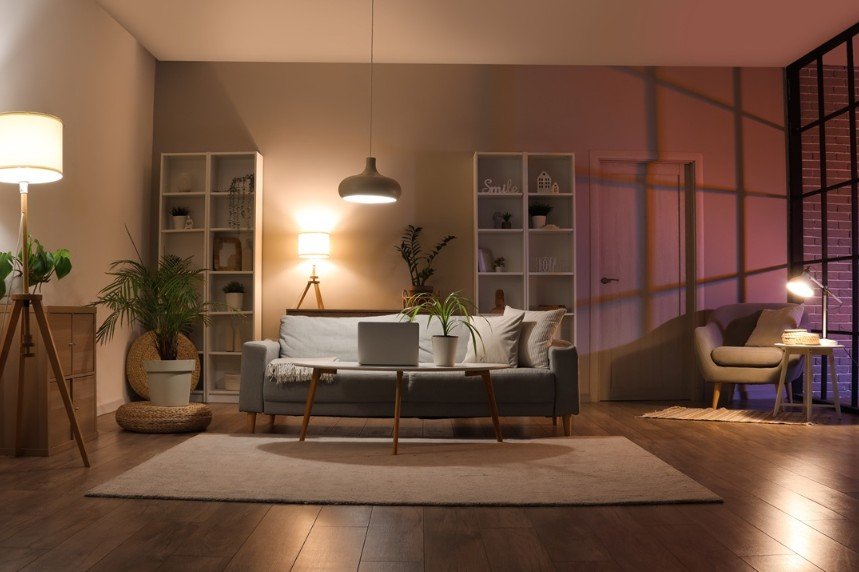
A living room may host television viewing, sewing, board games and reading. One strong overhead source tends to favour some of these activities at the expense of others. A reading chair benefits from a controlled nearby source that illuminates the page without shining into the reader’s eyes. Background wall or indirect light can reduce the contrast between a bright screen and a dark room. Distinct switching groups allow these uses to coexist without repeatedly changing the whole-room brightness.
When comparing LED for homes, consider the way family members occupy the space at different times rather than treating the sofa as the only activity centre. Mark armchairs, occasional tables, hobby storage and any temporary work position. Check reflections from a seated viewpoint, especially where television screens and glass doors are opposite ceiling fittings. A warm-looking evening setting may be comfortable in the seating area, while neutral task light at a hobby table can make small details easier to distinguish.
Treat bedrooms as spaces with several functions
Bedroom lighting needs to support dressing, finding stored items, reading and nighttime movement. A ceiling fixture can provide general visibility, while a bedside lamp places light close to a book without illuminating the entire room. Wardrobe interiors benefit from dedicated lighting because hanging clothes and shelves block light coming from the ceiling. In an existing wardrobe without electrical wiring, a suitable removable battery-powered luminaire may be a practical option, although charging access and runtime need consideration.
Mounting position matters more than the mere presence of a light. A wardrobe fitting close to the front often reveals clothing better than one hidden at the back. Avoid placing a bright emitter where someone lying in bed sees directly into it. Bedside controls should be reachable from the normal resting position, and two readers may prefer independent operation. If a bedroom doubles as a home office, separate the desk task light from the low-level sources used for relaxation.
Plan soft nighttime routes without losing visibility
At night, people may need to travel from a bedroom to a bathroom or kitchen. A full-output ceiling circuit can feel unnecessarily intense after waking. Carefully positioned low-level lighting along the route can reveal edges and obstacles while limiting direct glare. The fitting should illuminate a useful surface, such as the floor near a doorway, rather than becoming a bright point in the person’s field of view. Placement and mounting height are important in homes with different users and mobility needs.
Decide whether a dedicated switch, timer or sensor suits each route. A motion sensor should activate before the user reaches an unlit section and should not be continuously triggered by activity in an adjoining room. Keep the system simple enough for guests to operate. Review the route from actual bedroom doors after dark, taking account of reflections from mirrors and glossy bathroom finishes. Any fitting installed near water must be suitable for the location and meet applicable electrical requirements.
Keep the system adaptable as the household changes
Furniture moves, children grow and routines shift. A useful lighting plan allows task lights to be repositioned and provides sensible control groups that remain relevant after a room is rearranged. Document which lamps, strips, drivers and switches were installed, particularly where low-voltage components are hidden in joinery. Keep product identifiers and electrical ratings so that a later replacement can match the existing installation. For frequently used rooms, choose components whose cleaning and service requirements fit everyday access.
Seasonal daylight changes the experience of these rooms as well. A winter afternoon can leave the kitchen relying on artificial light much earlier than a summer evening. In a family living room, curtains and blinds affect the contribution from windows and can alter reflections on screens. Assess the lighting on a dark day as well as during bright weather so that the controls have a useful range under both conditions. If a household member develops a new hobby or begins working from home, adding a focused task source is often more effective than increasing every ceiling light to its maximum output.
Walk through the home in daylight, at dusk and late in the evening. Look at kitchen worktops while preparing food, read from the usual chair and test the corridor route with general lighting reduced. Ask different household members to operate the controls and identify anything difficult to reach. Residential lighting works well when each activity has appropriate visibility, the sources remain comfortable to view and no one needs to understand a complex system merely to move through the house.